Repository navigation
fix(native): resolve declarations in cascade order once an element's variables are set - #474
YevheniiKotyrlo wants to merge 6 commits into
Conversation


applyDeclarations reassigned its target parameter per declaration, and a
deferred declaration's closure captured that shared binding. The closure
runs after every declaration in the rule has been walked, so it read
whatever nested target the last declaration ended on: a deferred color
beside a box-shadow checked its placeholder against the shadow entry,
missed it, and left the internal { color: true } in the style.
-webkit-line-clamp: var(--n) left { numberOfLines: true } on the prop the
same way.

Each declaration now walks into a binding of its own.
A deferred declaration resolves after every other declaration of the
element, so a shorthand that resolved at runtime spread its keys over
whatever a later declaration had set: border: var(--b) followed by
border-color: blue painted the variable's colour, within a rule and across
rules, and so did border-inline-width: var(--w) over a later
border-inline-start-width. Each key belongs to the declaration that set it
last (css-cascade-5 §6.4).

Each element now records, per target and key, the cascade position of its
last writer. A deferred shorthand learns its keys only when it resolves, so
it claims them one by one and keeps the ones a later declaration holds.
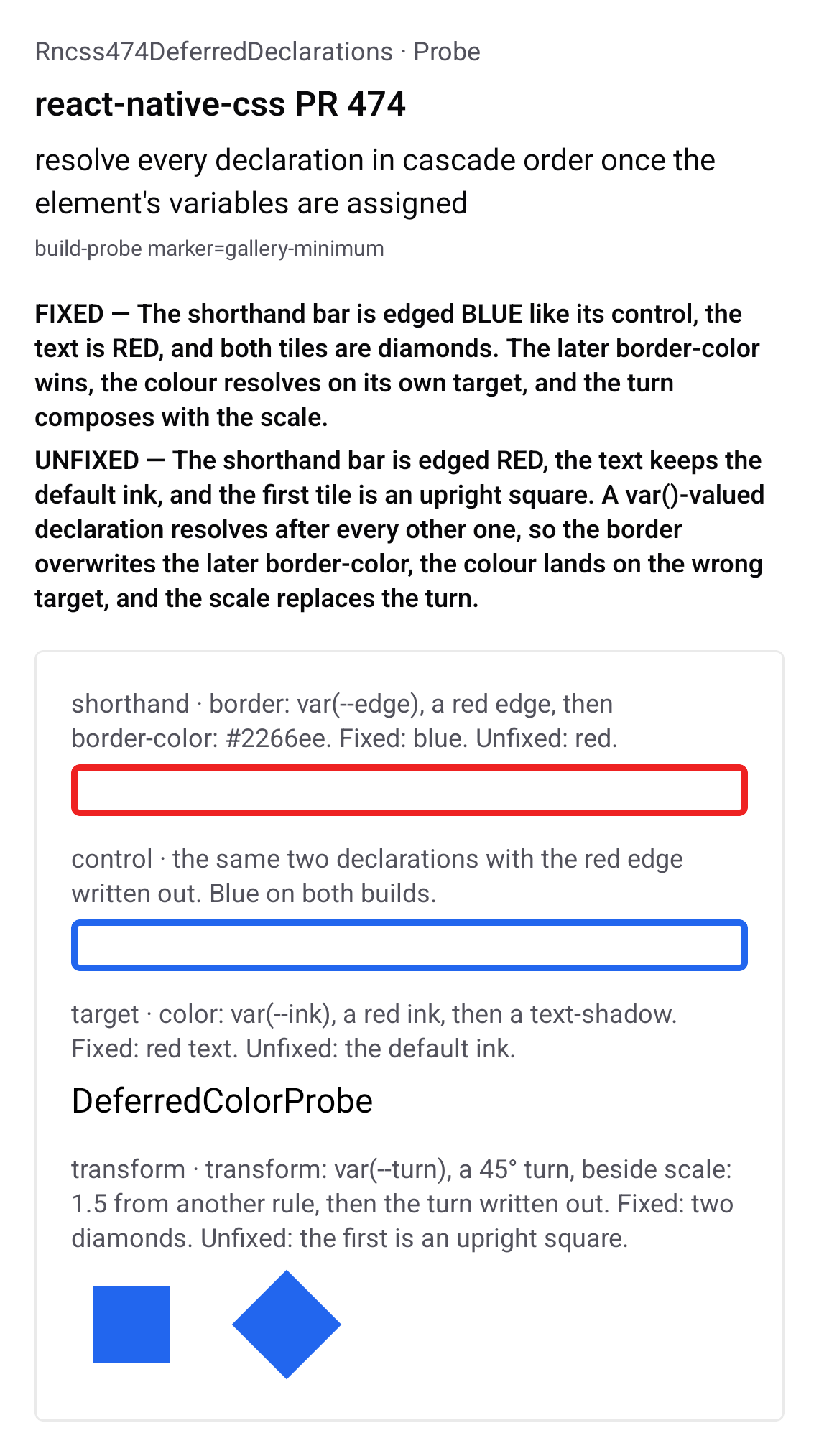
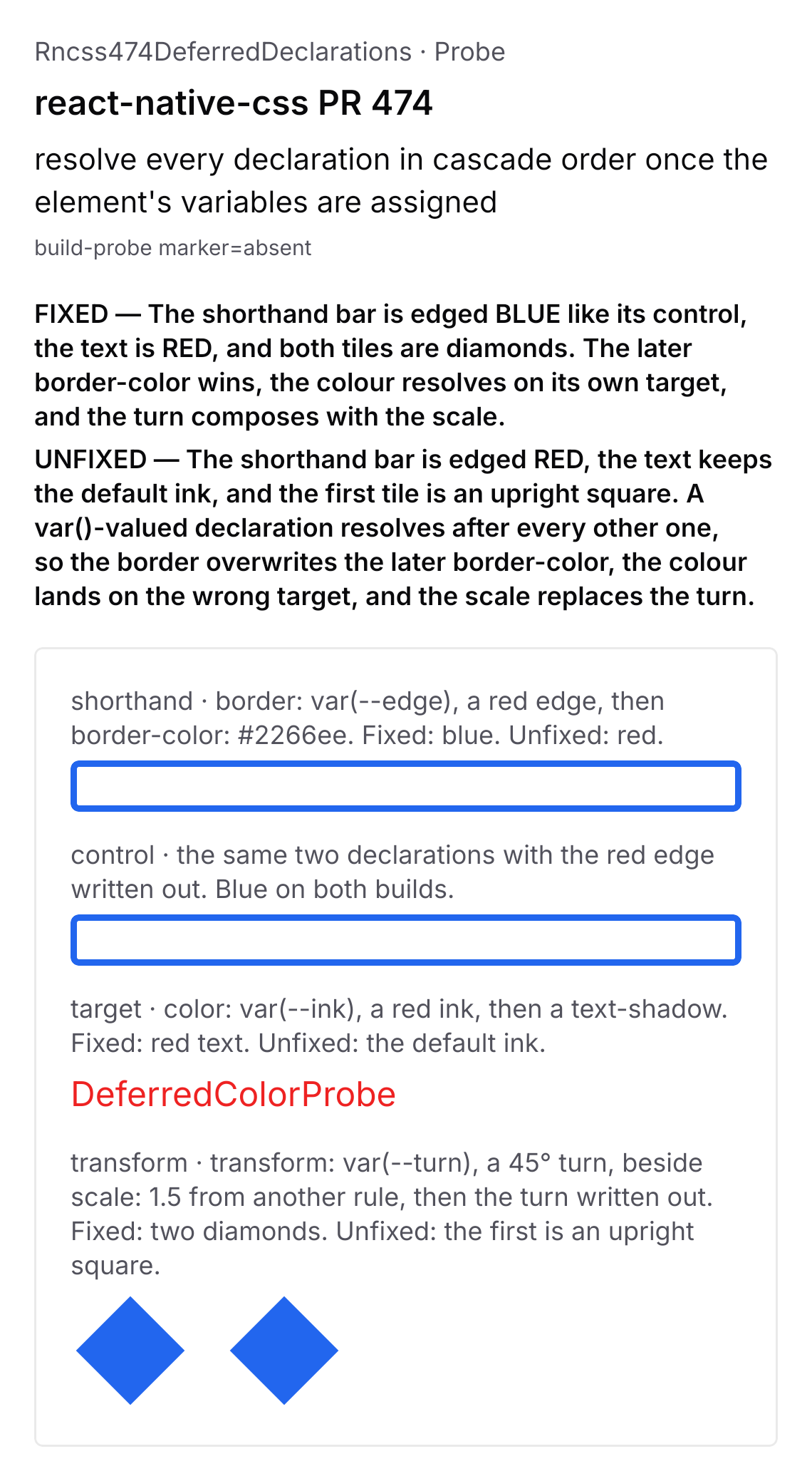
Device evidence — before / afterUNFIXED — The shorthand bar is edged RED, the text keeps the default ink, and the first tile is an upright square. A var()-valued declaration resolves after every other one, so the border overwrites the later border-color, the colour lands on the wrong target, and the scale replaces the turn. FIXED — The shorthand bar is edged BLUE like its control, the text is RED, and both tiles are diamonds. The later border-color wins, the colour resolves on its own target, and the turn composes with the scale.
Android 16 emulator (API 36, GLES on the host GPU), 1140×2400 @ 480dpi, both frames from one run; the second tile writes the turn out and is the control. |

A shadow that omits its colour takes currentcolor, which resolves as a
deferred declaration inside the shadow. On main its placeholder reaches
the style: textShadowColor: { textShadowColor: true } for a colourless
text-shadow beside a color, and color: { color: true } on a colourless
box-shadow entry under an inherited colour.
A later `text-shadow` writes its offset through `textShadowOffset.width`
and `.height`, and only the leaf was claimed, so an earlier
`text-shadow: var()` that resolved late still replaced `textShadowOffset`
whole: `.earlier { --s: 2px 2px blue; text-shadow: var(--s) }` before
`.my-class { text-shadow: 1px 1px red }` drew the red shadow at the blue
offset. A declaration written through a path now claims each key it
passes through.
The two text-shadow rows are about which declaration wins, so the
colour a variable carries is written in the form a runtime reader keeps
whether it serialises a named colour or not.
…ent's variables are assigned

A declaration that reads a var() was resolved after the walk, through a
placeholder at its key, so the walk had to remember which later declaration
set each key to keep a deferred shorthand off it. A placeholder is also what
an individual transform property replaced with an empty list, so
`.a { transform: var(--t) } .b { rotate: 45deg }` lost the transform.

Every rule's variables are now assigned before any declaration resolves, and
every declaration resolves in cascade order, so a later declaration overwrites
an earlier one as the browsers apply them and the key claims are gone. A
placeholder is left only for an individual transform property, which composes
into the transform list once every rule is walked. A runtime value that
resolves to nothing still resets the property.
YevheniiKotyrlo
changed the title
YevheniiKotyrlo
changed the title
This branch has not been deployed
1 participant

Problem
A declaration whose value reads a
var()resolves after every other declaration of its element, through a placeholder left at its key. Three defects onmainfollow from that:applyDeclarations's sharedtargetbinding, so it checked its placeholder against whatever nested target the last declaration ended on, missed it, and left the placeholder in the style.color: var(--c); box-shadow: 1px 1px bluerenderscolor: { color: true },text-shadowdoes the same,-webkit-line-clamp: var(--n)beside a deferred colour rendersnumberOfLines: { numberOfLines: true }, androtate: 45degbeside abox-shadowleaves{ rotateZ: true }in the transform and writes the rotation into the shadow.border: var(--b); border-color: bluepaints the variable's colour, within a rule and across rules.border-inline-width: var(--w)does the same over a laterborder-inline-start-width, an earlier rule'stext-shadow: var(--s)replaces a later rule'stext-shadow, andanimation: var(--a)replaces a lateranimation-duration..a { transform: var(--t) } .b { rotate: 45deg }renders the rotation alone, where browsers apply both.Solution
var()substitutes the element's computed custom property (css-variables-1 §3). Then every declaration resolves in cascade order, so a later declaration overwrites an earlier one as browsers apply them.transformlist once every rule is walked. Its closure keeps its own declaration's target.main.Tests
src/__tests__/native/deferred-declarations.test.tsx:box-shadow;var()with no value, and a written value the runtime cannot read, over an earlier rule's value.src/__tests__/native/animations.test.tsx: a writtenanimation-durationafter a variableanimation, with the variable inlined and kept.main, 14 of these 22 cases fail; the 8 that pass there are the ordersmainalready gets right, kept so they stay right.Verification
On Ubuntu with the workflow's steps - build, lint, typecheck,
yarn test,node --test node/__tests__/*.mjs, both library builds, the web export, the unstaged-changes checks and commitlint - everything passes.Device evidence, before and after: #474 (comment)
Merge order
#393 and #501 build on this, so this lands first.
It shares lines with #389, #391, #411 and #488 (
native/styles/calculate-props.ts); whichever lands second rebases. With #391, a declaration avar()leaves invalid at computed-value time resolves tounset, so the second of the two to land keeps that and drops this removal for a runtime value that resolves to nothing, which leaves one the runtime cannot read ignored.Base
Branched off
main(a5002c5).